Description
About This Video
Transcript
Read Full Transcript
Welcome back to our third practice this season. This practice will be focusing on hip work, We're gonna be starting in virasana, to work on learning how to fold the pelvis over the thighs as opposed to normally and sitting in cross legs. This gives us a little easier access to that hip hinge. We'll start by reaching behind to pull the skin and muscle back a little bit so that we really can feel the buttock bones into the block. Stretch down through the buttock bones and raise up the trunk.
And we'll keep practicing all that wonderful chest opening we've been working on this season. Roll the shoulders back and feel the shoulder blades help open the chest. We'll bring the palms together and the thumbs of the sternum, and gently press into the sternum with the thumbs and roll them up. Remember we want to feel the trapezius muscles relax and settle down the back. Before we close our eyes, check to make sure that there's no gripping, no hardening of the muscles around the hip joints here.
Be soft there that legs into the floor. And then we'll close the eyes. Let your attention settle down away from the thinking into the spaciousness of the chest and the lift of the spine. And more and more as we practice this opening, this centering meditation, And as we learn to lift and open the chest, you might begin to notice that there's a gravity to that space that becomes attractive to the attention. It's like a warm welcome to drop out of thinking.
And into a quiet stillness. And from that stillness, I say, Namaste, and again, welcome to our practice. We're gonna start off in Adamuka Virasana. We won't need the block anymore, setting that off to the side, knees wide feet together, And when I use the term hip hinge, this is the area I'm talking about, the folding of the pelvis over the thighs. I wanna remind you if your hip knees don't like to fold this deeply, take a folded blanket or two or three even if you need it and place it between your heels and your bottom, so you're not worried about any discomfort in the knees as we practice here.
Let's take the hands to the floor, and before we go into the pose completely, start to relax the thigh muscles, relax around the hip joints, allow those areas to settle down. And then staying soft in those areas will slowly work our way out into the pose. Remember if you need a block or folded blanket for your forehead, please don't be shy to take that. Then with our hands, we're going to gently push our body line backward toward the toes. And the feeling we're looking for here as we push the body back can see it. It's a subtle movement, but you can see it.
We're trying to cue that hip hinge to relax. No tension around there at all. Very, very soft muscles. So that backward pressure gives that cue to let go. Relax the ankles, relax behind the knees. And what you're hunting for is a downward settling of the body towards your yoga mat.
Every so often you might have to reset the hands, you get a gentle push. It's not hard at all. Just a few pounds of pressure to press back and settle. And softening of the hips is gonna be a major component of our practice. And then we'll slowly walk up and come into a sitting position.
We'll start out with a twist and hip hinge We'll call it the mermaid twist, where our left shin is right out in front of us and the right leg is brought back. Gonna turn over to the left side and then stretch out along the line of the yoga mat. The left arm is gonna remain bent and the right arm we're gonna reach. So as I reach, I turn my hips over as though down toward the floor. You come down as far as you like.
If you can rest the forehead on the floor, you can. If you wanna bring a block or folded blanket to help you settle in, You can do that as well. So in these poses, we're not pushing, we're not cranking, or anything like that. Rather, settle your attention around the hip, the pelvis, the low back, and look for more of a softness, a relaxing into. Remember the breath is a great way to start to feel what's happening in your body. Slowly unwind and come up and flip it to the other side. Right shin in front, left shin around to the side. We'll turn first.
I take my tension down there and settle any muscle tension that I don't need. I'm rolling the body over. And remember that right arm stays bent. It's kind of our prop. As the left arm reaches.
A few long, slow breaths. Experience your body. Look for areas, of course, that feel good, feel opening, but other areas that might say, it needs your attention. It's not feeling integrated in the pose. And then we'll unwind and come out.
Here's another twist. We'll take the left leg out and the right leg just behind. We'll turn again and reaching out. Now, you'll let the left leg fall open and the pelvis to come over, the knee will stay on the ground. Same use of the arms. And all of this is gonna serve to help us warm up the hips and bring the attention down to where we can really begin to see how our body's moving.
And later poses will come up slow. Two legs out front. This time the left leg brought back to basically a 90 degree angle. We'll allow the right leg, right foot to fall open, and then we're coming down into the pose. Slow soft breaths as you feel into your body, making adjustments and settling further into the pose with each passing breath.
And then we'll come out. And make our way into a downward facing dog. In our downward dog, let's raise up the heels nice and high. Again, attention to those hips, the hip hinge and look for a bit of softness in that hip hinge. So there's not a lot of aggressive muscle work there at all. We're trying to become a little bit more conscious and relaxing into that area. It. And then I use the hands to help press the spine line and torso line upward towards the tailbone.
And deepening that hip hinge crease. And when I pulse that a few times, There is a very special rolling of the legs. It's called the inward spiral that helps this hip hinge further. And that means we're gently rolling the fronts of the thighs inward toward the midline and the hamstrings outward away from the midline. And then we'll relax the dog pose, bring the left leg forward.
And just a classic lunge. Here again, I'm gonna hunt for a way to let go of some of that tension around the left hip. In this particular lunge, which is different from some of the other lunges I've shown, we're gonna let the back leg actually drop a little bit down. So that I feel that there's a turning of the pelvis over the left leg, a softening into that hip joint. You can lift up a little again, and again, a softening, a melting down.
And then we'll switch to the other side. Right leg forward lunge. Let's work the same practice. Unlocking some any muscle tension around that right hip, and then letting the back leg, the left leg sink a little to further cue our relaxing around the right hip. We can come up and try it again.
And again, it does take practice to feel deeper and deeper in the body. But it's remarkable how fast the body learns. And it builds practice after practice. You start finding new things. You have no idea was there the last time you did the pose.
And that's just It's the fun and the miracle of practice. Step back, dog pose, first side again, left leg forward. We'll bring a little of that softness again into the left hip, and we'll go into our lunge twist. Challenging to keep that softness. We don't wanna turn that into hardness around the left hip, and we'll bring the arm up.
And release and second side. Right leg forward, softening into the right hip, and we'll turn. Remember, we're looking for space. Nathan come down. Just a brief pause in down dog and then we'll walk it forward to a ragdoll pose. Here, you want to bend the knees quite a bit and it might take some exploration for you. As you bend the knees, your challenge is to bring your chest, your lower ribs against your thighs.
And for some people, it might be quite a bend almost even to 90 degrees before the chest will rest on the thighs. So let's find out where you need to be with your knee bend to allow as much of your chest to rest on your thighs as possible. And once you find that depth of bend, we're gonna hang out there and relax around the hip joints, release the back muscles. We can capture the elbows and hang down. The practice in this pose right now is relaxing around the hips, releasing the spinal muscles, relaxing the head.
And you may notice some heat building up in the thigh muscles. That's just part of the pose. Let's take a pause, hands on knees, let everything settle, come up, and we'll just pause there for a moment. And we'll take a deeper look at this ragdoll pose. Again, folding nice and softly over the hips, into the hip hinge, and letting into your pose. Relax the back muscles.
So we found that depth where chest and thighs are connected. I'm gonna reach back and grab hold of the backs of the calves. Relaxing the head down. Here's the challenge. Press your heels down into the floor and begin to raise your sits bones up, but without hardening at the hips. And without letting your chest, come away from the thighs.
You might get to straight legs. You might not get to straight legs. We're gonna do this in a pulsing way for five more times. Lift, soften, lift, soften, paying attention to the spinal muscles, letting them stay long, hanging down, hips, allowing that hinging to occur. We'll do one more.
Hands on the knees. Let's let everything settle for a few breaths. One more time hinge clasp, relax, and pulse. One, we'll do five. Two, softening around the hips. Three. Spinal muscles relaxing, letting the trunk down. Four.
And five. Hands on knees. Let everything settle. And we'll come up to full standing. Our next pose is called Malasana, and I'd like to show the first round with the help of a block.
And one other prop. The first step, I'm gonna stand around the block and then come down to it. Now, some people can take this pose. No problem here. If you'd like to go further, You could try it without the block and come all the way down here. Now, one challenge might be that the heels don't want to be down on the ground, so the heels are up.
Here's one way that you can work with that, and that is, you can take a folded blanket place just the heel bones on the blanket, and this can be a wonderful way to access this great pose without the tension of the calf muscles and ankle. So I'll take this first one with the blanket and we'll just work on it like this. In this pose again, I'm working on relaxing the hips to allow a deep hip hinge. So I have to feel into there. And I'm gonna work my body a little bit forward.
So I'll let the left knee open, bring the left torso a little forward. Let the right knee open. Bring the right torso a little forward. Pause for a minute. Let's try a little again.
Left and left torso. Right? Can you see my hand helping? Right torso? And then we've gotta allow those back muscles to relax into the pose. Okay. And we'll come back up to standing.
I'll put my blanket away. If you still need your blanket, please, you can keep it there. Once again, Malasana. Coming down Malasana's garland pose, and working into the hip hinge a little bit at a time, but this time we get to add a twist. I'll start by opening the right leg and helping the right torso around.
I'll bring the right hand just around. Notice my palm is up. Then pressing my arm against the leg to help turn. When I'm looking for a very specific effect beyond the twist, right at the base of the right hip, as I press into the twist, that area is allowed to come a little bit forward. Forward. And to take it a little bit deeper, if you'd like, you can clasp right behind the back to work on the twist and deep right side hinge.
A few more of these pulses to feel and observe that hip work. And we'll come out for a little rest. Relax the hips. You can move them around. And we'll do the second side. Last time, Malasana.
Going for the left side hip, I can push the knee open a little bit, bring the left torso and especially the left side pelvis. We wanna bring that forward as we're turning. Okay. And then once I feel I've got a good turn in place, I'll take the hand behind, left hand, with the palm up. I push the left hand against the leg and start my rotation. Remember what else I'm looking for? I'm looking for the left lower hip to come forward. And then we'll reach around to clasp.
If perhaps you need a strap to help with the clasp, it's a wonderful thing to take because the clasp really helps get the attention into the hip joint. We'll do a few more. And release that come up. Once again, let's move the legs around a little bit. And we'll go for tree pose.
Standing in tadasana, we'll bring the left leg up first, and I'll make a little space for my foot to attach. There we go. Here, we'll start with the arms down just to get a little bit of sense of the hip action. The sacrum and tailbone, we wanna roll down towards the right heel. That lifts the front of the body up.
That's all that wonderful chest work we've been doing. Sacrum and tailbone down. Lift the front of the spine up. Then with that stability, we'll take the arms all the way up, and we can go palms together. Breathing into the pose.
It's more like a meditation, this pose. So quiet. And then I Nathan release. Second side, right leg comes up, and we do want the right foot or the lifted foot to point straight vertical up and down. That helps us really open up at the groin. I'll take the sacrum and tailbone down.
Remember, when we do that, we're looking for an uplifting feeling in the front of the body. That's when when we're stable there. We can take the arms up. And if you have the room around the neck and shoulders to join the palms, it brings a further inner lift to the body. And then releasing.
Our next pose will be crescent warrior, and we'll take it into a hip hinge. So we'll start with the arms out. Palms up and then turn it around to the right side. Take a nice big breath in and exhale your way into warrior pose. And we're going up and down a little with the breath so that we can start to pulse into that right hip just a little deeper.
And like Malasana, I'm looking to descend the base of the right hip. And then with a nice deep pose, we'll come behind with the hands and interlock. Roll the shoulders back, and then we're into humble warrior folding deeply, pelvis over leg. Check in with that right hip, can you soften some of the muscles around the hip for that deep hip hinge? Come up slow.
We'll relax the arms and come to the second side. Right toes turned in. Left out. We'll take the arms up. And then bending into the left leg. And then I use my breath several times to help.
Dropping in a little bit more deeply into the left hip. I find a nice deep hold, take the hands and interlace behind the back, folding. Again, my target here is the folding of the hip, the left hip. So I'm feeling right there. Can I soften and deepen that crease? And then we'll come up, release the arms, and turn to center, and walk the legs into Taasen. Let's take a little pause and feel into the body.
And then we'll take our next pose, parsvottanasana. So I'll turn to the side, left leg forward, right leg back. And for this pose, three three and a half feet. You don't need an excessively long stance for this. I'll come down, hands to the floor. Now, if you need blocks to bring the floor up a little higher, if you find your body is quite rounded going to the floor, definitely use those blocks.
Will come down, but I'll have a slight bend in my front leg. And I'm gonna work on relaxing to allow the pelvis to turn over the left thigh. And then my challenge is straightening the leg, I'm not just going to push so that my spine goes right up. I'm gonna keep that hinge well folded and push the hips straight back. We'll do it one more time.
Bend the knee, focusing on softness, and then as I straighten the leg, I keep that softness in the hip deepening this fold increase, and I've got it. Then with that crease soft and deep, I let the back down. We're focusing as I stay on the depth of that hip and the release of the spine down. And then I'll come up bend the knee in out of the pose. Right leg forward, left leg back.
About three three and a half feet or so, and we'll do the second side, folding forward, and we'll bend the right knee a little bit. Take some time to focus in on the right hip and looking for some softness. As you press the right leg to straight, remember, we're gonna move the sacrum and tailbone pelvis straight back on a horizontal line. We don't wanna feel the spine jump up or round into the air. I'm aiming towards straight now in the right leg, and we'll do it one more time.
Make any adjustments you need to Nathan again, softness in the right hip, right hamstring, and then we're going to go for straight. On this side for me in particular, I've really got to take my time. I had an old injury in my right hip that loves to tighten up and protect. I take my time, and I go at its pace to feel that softening. And then I can feel it's allowed me to open the leg.
Now I'll take the pose. And sometimes it just takes so much patience to move at the body's speed, not the mind speed, you know, we're so eager sometimes to get into these poses. But we blow by a lot of the signals and language of our body. And then lifting up, bend the knee, and we'll come up out of the pose. First side again, left leg forward, right leg back. And we can take balance there.
We can take that depth in the hip a little further in a rotated triangle pose. So I'm gonna hinge right there, working on the depth of that hip again. We can even bend the knee a little, soften in the hip. I'll slide my right hand down, holding into that depth of the left. And begin to turn.
So again, Nathan, keeping the depth in that left hip. And as I slowly feel into it, I can take a rotated triangle pose. But it takes that sensitivity, developed practice by practice. And then we'll release, turning the chest down, and you can bend the knee to come out. Let's do the second side.
Three three and a half foot stance. We'll fold forward. We're paying attention to the right hip, giving it the freedom to turn, to turn to turn. I'll slide both hands down, as though I was going into the previous pose, and I'm gonna patiently watch and feel for the depth of the right hip, and then begin my turning. Each little turn I make, I check into the hip and see if it'll allow me to go further.
And this way, with this patient entry into the pose, I don't overdo another part When the hip is telling me, it won't let me go any further. So I don't crank the spine. I don't overdo it the shoulders. And as you can see, the breath is calm, steady. If it's available, you can take the top arm up. And then we'll come down and out of the pose.
We'll bring it together. A moment in tadasana to feel the body. Let the body settle, let the blood flow back through. And then our next pose will be eagle pose. We'll start with the legs together, and now that the hips have had that nice opening work, we'll take it a little deeper.
With eagle pose, we'll raise up the left leg first, bring it up and over across the right and pause. And if you need to use the arms, you can reach down and just assist the hook of the left leg. So for this one, because we're just working really on the hips today in this class, we won't do the arm interlock. We'll use the classic utkatasana Nathan come out. Wonderful pose for the hips.
We'll do the second side. Come down, feeling that hip hinge. Right leg comes up and over. I'll use my hands to help get that interlock. And then I roll this right leg around and there's an internal rotation to it and I make the hook or I try. There it is.
I'm gonna settle into the pose. Alright. The legs are steady, and I'll challenge the internal, that organic lift that I'm aiming at in the pose, that feeling of inner space. And then coming out. Our final standing pose, Prasarita Patatanasana, wide legs, toes turned in just a little bit, push down through the heels. You can see as soon as I do that, that lift comes into the body.
And with that lift in place, I'll fold forward and pause there. We'll let the knees bend just like we've been doing in the previous poses and start to feel where that hip hinging is happening. Alowing the hip to hinge, I'll slowly press the heels and begin to straighten the legs while keeping that hip hinge soft and deepening. Nathan you may be able to see as I do that with the legs, my body is just just falls forward. It does take practice, you know, to feel that depth in the hips.
And so I'm keeping that hip hinge soft, aware. I'm feeling if the body is telling me too deep or if there's more space to go. And we'll let's be in this pose for a little bit. And with the awareness into that hip hinge, I want to feel that it goes on getting deeper and deeper. And contact. And then we'll slowly come up out of the pose.
We'll heel toe the feet together, and we'll come down into a kneeling position to pause. And just feel the body. Let your eyes close and the awareness to trace through your body. See how your practice is evolving. From here, let's come on down to a sitting position.
We'll extend the legs forward and start with some deeper hip work from this position. I'll start with the left leg and bringing the leg up. We'll just do a little swinging just like this. And this is bringing the attention to the left hip and pelvis. And then as you're able, we're gonna slowly bring that left shin closer and closer to the chest.
If you can, you can either grab with a forearm or possibly hook into the elbow. Just gonna adjust the sitting stance so that both the sitting bones are at the same position, and then cradle the leg in. Before you just try to pull the leg into the chest, take your attention to that left hip and soften soften soften. Then when you feel that softness, you can start to bring the leg in. It's nice to just gently pull in and then release a little.
So each time you can feel there are more muscle fibers that you can begin to relax. So this becomes more of a melting than a pulling. And then we'll release and do the second side. Briner the right side in. We'll start with just a little open and close.
We start to feel, bring the attention and awareness down the right side hip. And then I'll see if I can clasp and bring it in. And right around to the elbow. But you go to the depth that you're able to go, and I'll hang on to the shin. I'm lifting up, and at the same time, I'm deepening that groove, the hip hinge.
My pulse in a little into the softening that the hip is allowing, and releasing, and in, and releasing, and in. And releasing, and we'll let it go. Our next pose is John Ashshasana, a little variation on that theme, and I'm gonna bring a block into play for this. I'm gonna sit up on the block, and this gives me a little extra space for my knee to fold. So what I'm doing, I'm bringing the foot underneath and my goal is the head of the knee, that knee bone right there.
I want it to point straight down straight down into the floor. Other leg is out straight ahead as in classic, Janesh Shasana. With the hip up like this, it helps propel the pelvis more into a forward bend than if you're sitting on the ground. And when you like, you can try the difference between the two to feel this. So as I come forward, of course, the hip hinge, and I'm following that left hip over.
You can kinda see my waist band starting to fall forward into the pose. So I'll take some time, always feeling into the hip, I'm pausing there. And this knee, I'm gonna push it straight down into the floor as though it propels me to help bring me a little bit more forward. Settling in slowly. And then coming up.
We'll extend the left and work to the right. Once again, the head of the knee pressing down to the floor and softening into the hip hinge to the left. And working in at its pace. I use the arms. It's just a little gentle traction. And then coming out.
We'll extend both legs. And next is Crown Chasana. I'm gonna be taking the left leg folded back like virasana. The right leg will just start by bending and get settled on the hips. I'll draw back that right leg a few times getting that pulse, getting my familiarity with the hip. And I'm gonna catch that foot and start to bring it up.
Now here I have to pay attention to that right hip so it stays soft and descending, and I'll begin to press the leg toward the ceiling, but all the while keeping that hip. Just like we've been practicing. You pause, pause whenever you need to. And remember, softening into the right hip, we come up, we can grab hold of the hands, and work into that depth. Crownchasana. And release, I will do the second side.
Left leg long, right leg folded back in half virasana, half hero's pose, and get the hips settled, and bring the leg up and teach the left hip to settle and soften the deepen. Grab the foot, paying attention to the left hip as I extend. There we go. Nice strong leg. Coming up. Can clasp the hands.
And then we'll ease out of the pose and come down. We can put the block Nathan, and I have a challenge pose for you. I'm gonna start with the legs out. And now that we've warmed up and mobilized that hip quite a bit, we can make a challenge. I'm gonna take the right leg up, give a few pulses to open up the hip.
Hold it with the right left hand. And bring the right arm through. We're gonna do this several times to get the right arm well tucked in. Remember that work we did on the hip? This is all gonna play through in this pose. See that hip moving forward?
Here comes the challenge. We're gonna pull this heel down towards the buttock and push this leg down into the floor to lift the bottom. And then second leg. And come down at rest. What a pose. A lot of abdominal strength.
We'll go to the second side. I'm lifting up. We'll bring the foot up. Do a few pulses just to cue the hip work that we've been doing. Right hand holds on so the left hand can come under.
We're gonna do just a little lift onto the shoulder. And then I work that arm to begin getting that left hip work that we've been working throughout this practice session. You can pause anywhere along these stages that we're doing wherever your body says, That's its end point for the day. I let go of the foot. I'm gonna pull actively.
We use the hamstring and pull the foot down and push that leg into the floor. I raise my bottom. And then the second leg. Exhale, and we're up. And then come down and rest. Great work. It's time for a good rest.
So we'll turn on to the mat. And lie down, and just let the body recover. It's nice to cross the legs a little bit, letting the lower back settle. I'm doing this kind of hip work can bring a great piece to the nervous system and mind, actually, because there can be a lot of tension we hold around the hip muscles. Those hips have to stabilize us and hold us up right.
They're working a lot during the day. So being able to calm those muscles down can help just calm the nervous systems relationship to those muscles. Everything starts to calm down. We can bend the knees and just do a little bit of windshield wiper action. This helps to mobilize the lower back.
Remember, feel into your body at this point. Is there tension? Is there discomfort anywhere? Did you overdo We want to listen to those signals, and they're not wrong signals. It's part of the learning process in yoga, and it goes on and on learning like that.
But that is the gift of the practice because we get to grow our awareness and learn all about ourselves. We're gonna finish with halasana, that's plow pose and shoulder stand. I'll do the familiar three blankets set up. And remember, we do have the tutorial on shoulder stand and variations that you can do to build into that practice. One, two, and three.
So we'll be going through plow pose first and then into shoulder stand. I'll place the block for a little, little hip support and notice I've got the three folded edges nice and neatly stacked. Here we go. Settle my hips up on the block and bring the shoulders down. Remember to adjust your shoulders just off the front line of the blankets so that your shoulders have a space to roll Nathan.
And all set. I'm gonna hold on to the mat for some stability to help me go over. I take a breath in, exhale and bring the legs up and over. Then holding on to the mat. I can open the legs just a little bit tilt to the side, I'll bring my right arm under, left side, right side, left side. And I think it's a good point to make here as you're learning and practicing.
You don't want to be watching the the video as you're learning to do these kinds of poses because the neck is in a deeply flex position. It's better to watch and then follow through, so you're safe with the neck. I'll let go of the mat and bring my hands flat against the back to help lift me toward the ceiling a little bit more. And we're in plow pose. Here again, following through with this practice, I'm allowing those hip sockets to be soft.
And then we'll take this up into full shoulder stand. So I'll walk in my feet a little bit stretch one leg up and pull the other leg up with me. And here, we're unfurling those legs, unfurling the hip joints, reversing the blood flow. At any point, you feel that there's undue tension on the neck. There's no reason to stay in this pose.
You can just take a supported bridge. These inversions do take time and practice to feel comfortable in. So please, no rush, no rush. We have all of our lives to learn these poses and gain the benefits. And really, the learning experience, as they say, the journey is the destination.
That's really where it's at. That's where we grow. I'm gonna just stay a short little while today. And coming down, you can use either one leg or both legs at the same time. Arms overhead.
And allow your body to gently roll out of top pose. The neck relax and touchdown. We'll do a little wiggle. So that our body, upper body, anyway, most of our ribcage comes down to the floor. Let's let this be our little recovery pose.
And so what we're waiting for here is that the body's gonna settle down the blood pressure, the heart rate, all of that is nice and slow again, and then we'll take it to Shawasana. And then we'll do a little turn to the side. Come on up, and put the things away. We'll use one blanket for Salasana. The other two we won't need.
Alright. A nice long spine coming down into the pose. Adjust the head side blanket. So it's underneath the head and the neck. We can lengthen out the back of the pelvis, gentle tuck of the shoulders, to support open the chest, and then one leg at a time. Gently pressing the feet into the floor to help relax the groins that we've been working with all day, all practice long, and slowly take the energy.
Out of the legs. Take your time. Take your time. Take your time. Same with the arms. Give them over to gravity.
With your arms and legs settled in the ground, you're slowly drawing your awareness and attention away from the periphery toward the center. Relaxancing your facial muscles around the lips, the nose, the eyes, the ears, temples. A good feeling is as though you're deflating all of those areas. And we'll settle into the soft quietness of the chest. And as always, if you'd like to stay longer, please do.
We'll finish by resting the hands, one on chest, one on the tummy. One leg at a time, bend the knees and turn to your right side. We'll rest on the side for just a few breaths. And then you can turn toward the floor and slowly press your way to sitting. Let's just take a quick second to rest in a sitting position.
Let the eyes close and your hands to rest on your thighs. And as always, it's my pleasure to be here with you. Thank you so much for coming, and we'll see you soon.
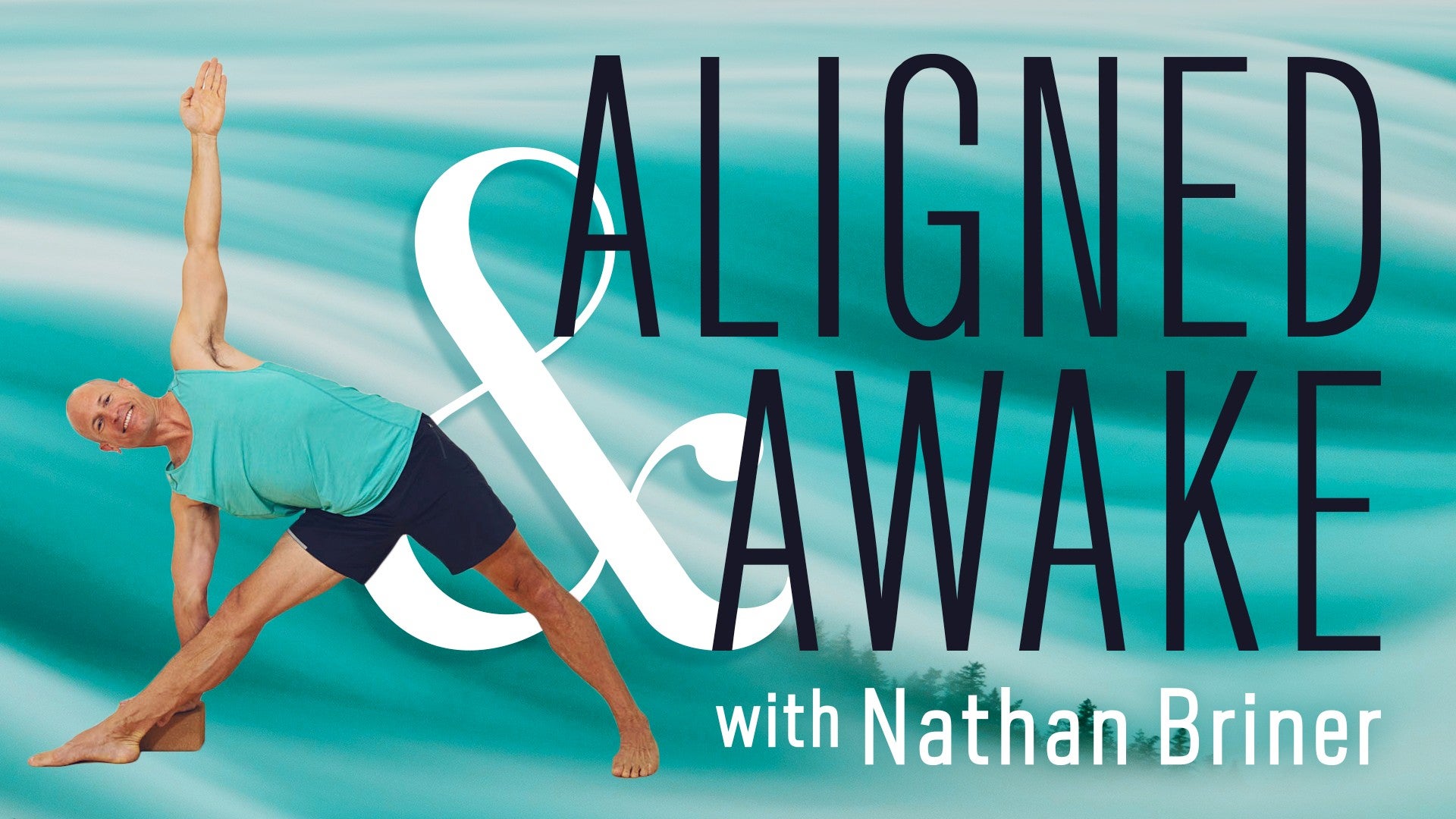
Aligned and Awake: Nathan Briner


Comments





You need to be a subscriber to post a comment.
Please Log In or Create an Account to start your free trial.